
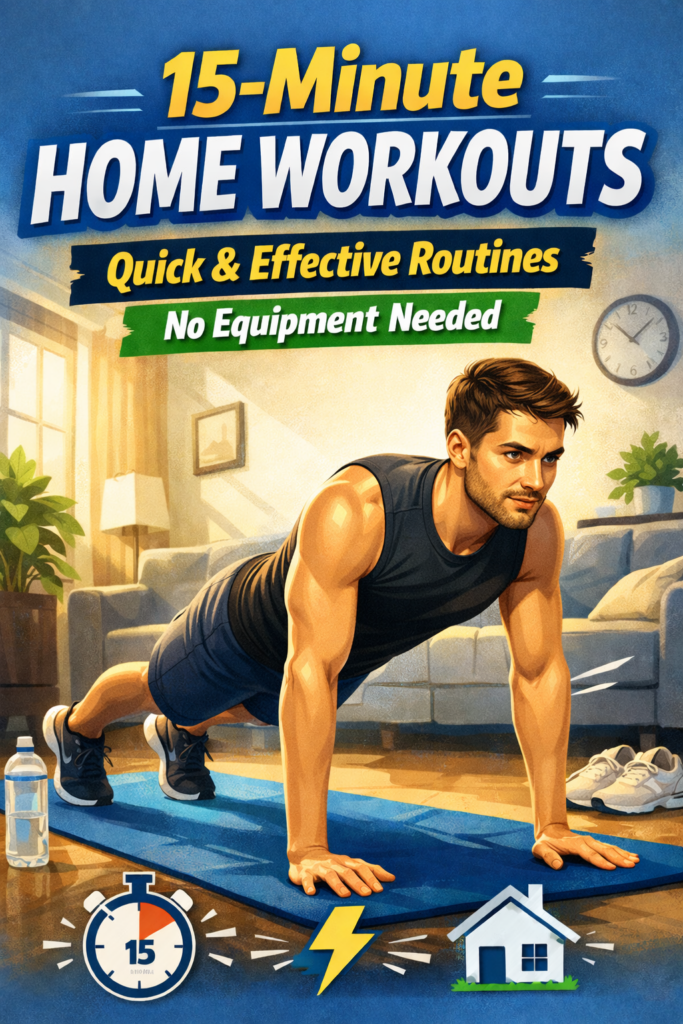
Introduction
“No time? No gym? No equipment? No problem!”
Let’s be real — life is busy. Between work, family, and everything else on your plate, finding time to exercise can feel impossible. But here’s the good news: you don’t need a gym membership, a fancy machine, or even an hour a day to start transforming your body and energy levels.
Just 15 minutes is enough. Research shows that short, focused workouts done consistently are far more effective than long sessions you never actually get around to doing. This guide gives you ready-to-use home workouts no equipment — grab your water bottle and let’s get moving.
Why 15-Minute Workouts Actually Work
15Minutes is all you need
24hAfterburn metabolism boost
3×Weekly sessions recommended
Short workouts are sustainable for busy people. When something feels manageable, you actually do it — and consistency is the real secret to results. A 15 minute workout fits into a lunch break, a morning before the kids wake up, or right after dinner.
High-intensity movement in a short time triggers the “afterburn effect” (technically called EPOC — excess post-exercise oxygen consumption). This means your body keeps burning calories for hours after you stop. And the best part? You can get this benefit from home workouts no equipment using only your bodyweight.
Consistency over perfection is the real game-changer. It’s easier to commit to 15 minutes daily than to dread a 60-minute gym session. Show up small, and the big results will follow.
The Warm-Up (2 Minutes)
Never skip the warm-up! It primes your muscles, raises your heart rate gently, and dramatically reduces your risk of injury. Keep it simple:
- Arm circles — 30 seconds. Roll your arms forward and backward in big circles to loosen your shoulders.
- Torso twists — 30 seconds. Stand with feet hip-width apart and rotate your upper body side to side.
- High knees or jogging in place — 60 seconds. Drive your knees up toward your chest to get your blood pumping.
The Main Workout: 10 Minutes
This is a full-body circuit. Perform each exercise for 45 seconds, then rest for 15 seconds before moving on. After completing all 5 exercises, rest for 60 seconds, then repeat the entire circuit one more time.
45s work 15s rest Repeat × 2 rounds
1-Bodyweight Squats
Stand feet shoulder-width apart, toes slightly out. Push your hips back and bend your knees like you’re sitting into a chair. Keep your chest up and don’t let your knees cave inward.
Glutes · Quads · Core
2-Push-Ups (on knees for beginners)
Place hands slightly wider than shoulders. Lower your chest toward the floor, then press back up. Beginners: drop to your knees. Keep your body in a straight line — don’t let your hips sag!
Chest · Shoulders · Triceps
3-Reverse Lunges
Step one foot backward and lower your back knee toward the floor. Return to start and alternate legs. Keep your front knee above your ankle and your torso tall.
Legs · Balance · Glutes
4-Plank Hold
Get into a push-up position and hold still. Squeeze your abs, glutes, and thighs. Breathe steadily — don’t hold your breath! Drop to your knees if needed.
Core · Stability · Full Body
5-Mountain Climbers
Start in plank position and drive your knees toward your chest one at a time in a running motion. Go at a pace that challenges you — faster = more cardio, slower = more core.
Cardio · Core · Shoulders
The Cool-Down & Stretch (3 Minutes)
Cooling down is not optional — it helps your heart rate return to normal, prevents dizziness, and reduces next-day muscle soreness. Skipping this step is one of the most common mistakes beginners make.
- Quad stretch — 30 seconds each leg. Stand on one foot, pull the other heel toward your glute, and hold gently.
- Hamstring stretch — 30 seconds each leg. Sit on the floor with one leg extended, reach toward your toes and hold.
- Child’s pose or torso stretch — 60 seconds. Kneel and stretch your arms forward on the floor, or stand and side-bend each way for a full torso release.
Benefits of No-Equipment Workouts
Still wondering if this style of training is “enough”? Here’s why no equipment workout for beginners is one of the most underrated fitness strategies:
- Free and accessible anywhere — your hotel room, living room, or backyard all work perfectly.
- No travel time to the gym — the 20 minutes you save commuting is time you can actually use to work out.
- Uses body weight effectively — your own body provides all the resistance you need to build real strength and tone.
- Builds functional strength — these movements mimic real-life actions, making daily tasks easier and reducing injury risk.
- Easy to modify for any fitness level — too easy? Add reps. Too hard? Slow down. Every exercise is adjustable.
Tips to Maximize Your 15-Minute Workout
- Focus on form over speed. Sloppy reps lead to injury. Move with intention — quality beats quantity every time.
- Stay hydrated. Drink a glass of water before your workout and another right after. Don’t wait until you feel thirsty.
- Track your progress. Write down your reps, or time yourself. Try to increase reps or shorten rest periods every week.
- Combine with healthy eating. Exercise alone won’t create dramatic weight loss — pair your home exercise routine with balanced, nutritious meals for the best results.
Sample Weekly Schedule for Beginners
Here’s a simple, balanced weekly plan to follow. Rest days are just as important as workout days — your body grows stronger during recovery.
| Day | Activity | Type |
|---|---|---|
| Monday | 15-min full body circuit | Workout |
| Tuesday | Active rest — 20-min walk | Light |
| Wednesday | 15-min full body circuit | Workout |
| Thursday | Full rest day | Rest |
| Friday | 15-min full body circuit | Workout |
| Saturday | Light activity or longer walk | Light |
| Sunday | Rest or gentle stretching | Rest |
Common Mistakes to Avoid
- Skipping warm-up or cool-down. These aren’t optional — they protect your joints and muscles.
- Holding your breath during exercises. Breathe out on the hard part, breathe in on the easy part. Keep it flowing.
- Rushing through movements. Faster isn’t always better. Control the movement to work the right muscles.
- Doing the same routine every single day with no progression. Your body adapts quickly — add reps, reduce rest, or try harder variations to keep making progress.
Conclusion
You don’t need a gym, expensive gear, or hours of free time to get fit. The best home workouts no equipment are the ones you actually show up for — and 15 minutes is absolutely enough to start seeing real, meaningful changes in your body and energy.
If 15 minutes feels too long at first, start with 10. Seriously. A 10-minute workout done consistently will always beat a perfect 60-minute plan you never follow through on. Start small, stay consistent, and let momentum do the rest.
Ready to start your fitness journey?
Frequently Asked Questions (FAQ)
Q: Can I do this workout every day?
You can do light movement daily, but aim to do this specific circuit 3–4 times per week with rest or active recovery days in between. Your muscles need time to repair — that’s when they actually get stronger. Overdoing it, especially as a beginner, can lead to burnout or injury.
Q: Will a 15-minute workout really help me lose weight?
Yes — especially when combined with a healthy diet. A short, high-intensity session boosts your metabolism and burns calories both during and after the workout. Consistency over weeks and months is what produces lasting weight loss. This 15 minute workout is a powerful starting point, not a magic fix.
Q: What if I can’t do push-ups?
Totally normal! Start with wall push-ups (standing and pressing against a wall), then progress to knee push-ups, and eventually work up to full push-ups on your toes. Every version works your chest, shoulders, and arms — the key is to keep moving and keep trying. You’ll get there faster than you think.